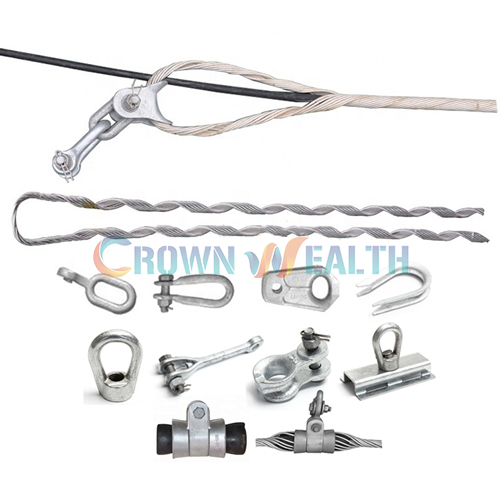
Hey there! As a link fitting supplier, I've been in the business for quite some time, and I've seen all sorts of link fittings out there. In this blog, I'm gonna share with you the different types of link fittings that are commonly used in various industries.


First off, let's talk about what link fittings are. Simply put, link fittings are components used to connect different parts of a structure or a system. They play a crucial role in ensuring the stability and functionality of the whole setup. Whether it's in construction, electrical, or mechanical applications, link fittings are everywhere.
1. HDG Parallel Groove Clamp
One of the popular types of link fittings is the HDG Parallel Groove Clamp. These clamps are mainly used in electrical systems. They're designed to connect two parallel conductors together. The "HDG" stands for Hot - Dip Galvanized, which means they have a protective zinc coating. This coating helps prevent corrosion, making the clamps durable even in harsh environments.
The parallel groove design allows for a large contact area between the conductors and the clamp. This results in low resistance and efficient electrical conductivity. You'll often find these clamps in power distribution networks, where they're used to connect overhead power lines or in underground cable systems. They're easy to install too. You just need to place the conductors in the grooves and tighten the bolts, and you're good to go.
2. PD Clevis
Next up is the PD Clevis. A PD Clevis is a type of mechanical link fitting. It has a U - shaped design with holes at the ends. These holes are used to attach other components, like pins or rods. PD Clevises are commonly used in machinery and equipment where there's a need for a flexible connection.
For example, in a hydraulic system, a PD Clevis can be used to connect a hydraulic cylinder to other parts of the machinery. It allows for some degree of movement and rotation, which is essential in systems where parts need to move in different directions. The design of the PD Clevis also makes it easy to disassemble and reassemble, which is great for maintenance and repairs.
3. P - Type Clevise
The P - Type Clevise is another interesting link fitting. Similar to the PD Clevis, it's also used for making connections in mechanical systems. The P - Type Clevise has a slightly different shape compared to the PD Clevis. It has a more rounded, P - like form.
This type of clevise is often used in applications where there's a need for a strong and stable connection. It can handle high loads and stresses, making it suitable for heavy - duty machinery. You might see P - Type Clevises in construction equipment, such as cranes or excavators, where they help transfer forces between different parts of the machine.
Other Types of Link Fittings
Apart from the ones I've mentioned above, there are many other types of link fittings. For instance, there are eye bolts. Eye bolts have a loop at one end and a threaded shaft at the other. They're used to attach ropes, cables, or chains to a structure. You can find them in lifting applications, like when you're hoisting heavy objects.
Then there are turnbuckles. Turnbuckles are used to adjust the tension in cables or rods. They have two threaded ends that can be turned in opposite directions to either tighten or loosen the connection. You'll often see turnbuckles in suspension bridges or in some types of fencing to keep the wires taut.
There are also shackles. Shackles are U - shaped with a pin or bolt to close the opening. They're used to connect different components quickly and easily. You can use shackles in marine applications, like on boats to attach ropes or chains, or in industrial settings for rigging purposes.
Choosing the Right Link Fitting
When it comes to choosing the right link fitting for your project, there are a few things you need to consider. First of all, you need to think about the load requirements. How much weight or force will the fitting need to handle? If you're working on a heavy - duty application, you'll need a fitting that can withstand high loads, like a P - Type Clevise.
The environment is also important. If the fitting will be exposed to moisture, chemicals, or extreme temperatures, you'll need to choose a fitting that's resistant to these conditions. For example, the HDG Parallel Groove Clamp with its hot - dip galvanized coating is a great choice for outdoor electrical applications where corrosion is a concern.
Another factor is the type of connection you need. Do you need a flexible connection that allows for movement, like a PD Clevis? Or do you need a rigid connection for a more stable setup?
Why Choose Us as Your Link Fitting Supplier
As a link fitting supplier, we take pride in offering high - quality products. We source our materials from reliable suppliers and use advanced manufacturing processes to ensure that our link fittings meet the highest standards.
We have a wide range of link fittings in stock, so you can find exactly what you need for your project. Whether it's a common fitting like an eye bolt or a more specialized one like a P - Type Clevise, we've got you covered.
Our team of experts is always ready to help you. If you're not sure which fitting is right for your application, just give us a shout. We can provide you with technical advice and guidance to make sure you make the best choice.
And we offer competitive prices. We understand that cost is an important factor in any project, so we strive to keep our prices reasonable without compromising on quality.
So, if you're in the market for link fittings, don't hesitate to get in touch with us. We're here to make your project a success by providing you with the best link fittings and excellent customer service. Whether you're a small - scale DIYer or a large - scale industrial client, we can meet your needs. Let's have a chat about your requirements and see how we can work together.
References
- Electrical Fitting Handbook
- Mechanical Components and Their Applications
- Industrial Link Fitting Guide