The damping ratio is a crucial parameter in understanding the performance of a Spiral Vibration Damper. As a leading supplier of Spiral Vibration Dampers, I am often asked about this key characteristic. In this blog, I will delve into what the damping ratio of a Spiral Vibration Damper is, why it matters, and how it affects the overall functionality of these essential devices.
Understanding the Basics of Vibration Damping
Before we can fully grasp the concept of the damping ratio, it's important to understand the basics of vibration damping. Vibration is a common phenomenon in many engineering applications, especially in overhead power lines, where wind-induced vibrations can cause significant problems. These vibrations can lead to fatigue failure of the conductors, reduced lifespan of the equipment, and even power outages.
A Spiral Vibration Damper is designed to mitigate these vibrations by absorbing and dissipating the energy generated by the oscillations. It does this through a combination of mechanical and material properties that work together to reduce the amplitude of the vibrations.
What is the Damping Ratio?
The damping ratio, often denoted by the Greek letter ζ (zeta), is a dimensionless parameter that describes how oscillations in a system decay after a disturbance. In the context of a Spiral Vibration Damper, the damping ratio indicates how effectively the damper can reduce the amplitude of the vibrations over time.
A damping ratio of 0 represents a system with no damping, where the vibrations will continue indefinitely without any decay. On the other hand, a damping ratio of 1 represents a critically damped system, where the system returns to its equilibrium position as quickly as possible without any oscillations. Values between 0 and 1 indicate an underdamped system, where the vibrations will decay over time but will still exhibit some oscillations. Values greater than 1 represent an overdamped system, where the system returns to its equilibrium position slowly without any oscillations.
Importance of the Damping Ratio in Spiral Vibration Dampers
The damping ratio is a critical factor in determining the performance of a Spiral Vibration Damper. A damper with a high damping ratio will be able to quickly reduce the amplitude of the vibrations, minimizing the stress on the conductors and other components. This can significantly extend the lifespan of the equipment and reduce the risk of fatigue failure.


Conversely, a damper with a low damping ratio may not be able to effectively reduce the vibrations, leading to increased stress and potential damage to the system. Therefore, it is essential to select a Spiral Vibration Damper with an appropriate damping ratio for the specific application.
Factors Affecting the Damping Ratio
Several factors can affect the damping ratio of a Spiral Vibration Damper. These include the design of the damper, the materials used, and the operating conditions.
The design of the damper plays a crucial role in determining its damping characteristics. A well-designed damper will have a shape and structure that allows it to effectively absorb and dissipate the energy of the vibrations. For example, the spiral shape of the damper helps to increase the surface area available for energy absorption, while the internal structure can be optimized to enhance the damping effect.
The materials used in the damper also have a significant impact on its damping ratio. Different materials have different mechanical properties, such as stiffness and damping capacity. For example, rubber and other elastomeric materials are often used in Spiral Vibration Dampers because they have high damping capacity and can effectively absorb and dissipate energy.
The operating conditions, such as the frequency and amplitude of the vibrations, the temperature, and the wind speed, can also affect the damping ratio. For example, at higher frequencies, the damping ratio may decrease, while at lower temperatures, the stiffness of the materials may increase, affecting the damping performance.
Measuring the Damping Ratio
Measuring the damping ratio of a Spiral Vibration Damper can be a complex process. There are several methods available, including experimental testing and numerical simulation.
Experimental testing involves subjecting the damper to a known vibration source and measuring the response of the system. This can be done using specialized equipment, such as accelerometers and strain gauges, to measure the amplitude and frequency of the vibrations. The damping ratio can then be calculated based on the measured data.
Numerical simulation, on the other hand, involves using computer models to simulate the behavior of the damper under different conditions. This can be a more cost-effective and efficient method, especially for predicting the performance of the damper in different operating scenarios.
Applications of Spiral Vibration Dampers
Spiral Vibration Dampers are widely used in various applications, including overhead power lines, telecommunications towers, and industrial machinery. In overhead power lines, they are used to reduce the vibrations caused by wind, preventing fatigue failure of the conductors and other components. In telecommunications towers, they help to stabilize the structure and reduce the effects of wind-induced vibrations. In industrial machinery, they can be used to reduce the noise and vibration levels, improving the performance and reliability of the equipment.
Related Products
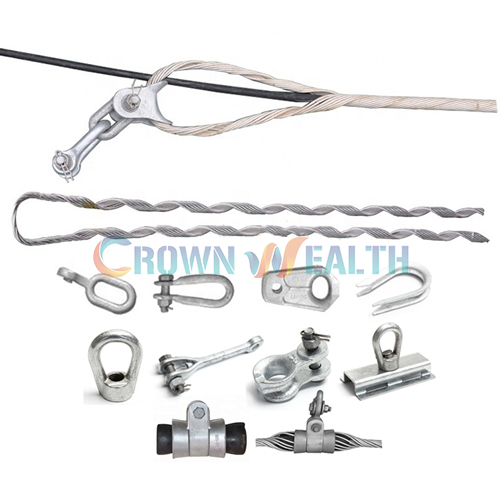
In addition to Spiral Vibration Dampers, we also offer a range of related products, such as Helical Guy Grips, Overhead Line Accessories Preformed Dead End Clamp Guy Grip for Cable, and Dead End Guy Grips. These products are designed to work together to provide a comprehensive solution for vibration control and structural stability.
Conclusion
The damping ratio is a critical parameter in understanding the performance of a Spiral Vibration Damper. It indicates how effectively the damper can reduce the amplitude of the vibrations over time, which is essential for minimizing the stress on the conductors and other components. By understanding the factors that affect the damping ratio and selecting a damper with an appropriate damping ratio for the specific application, you can ensure the optimal performance and reliability of your system.
If you are interested in learning more about our Spiral Vibration Dampers or other related products, or if you have any questions about the damping ratio or other technical aspects, please feel free to contact us. We are always happy to help and look forward to discussing your specific needs and requirements.
References
- Mechanical Vibrations, Rao S. S., Pearson Education, 2011.
- Handbook of Vibration Engineering, Singh R., Springer, 2011.
- Power System Engineering, Wood A. J., Wollenberg B. F., Wiley, 1996.