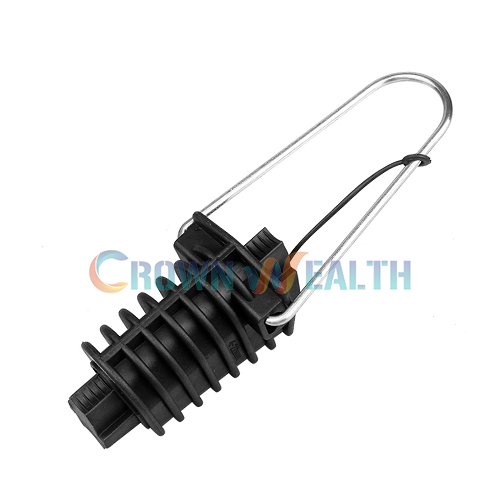
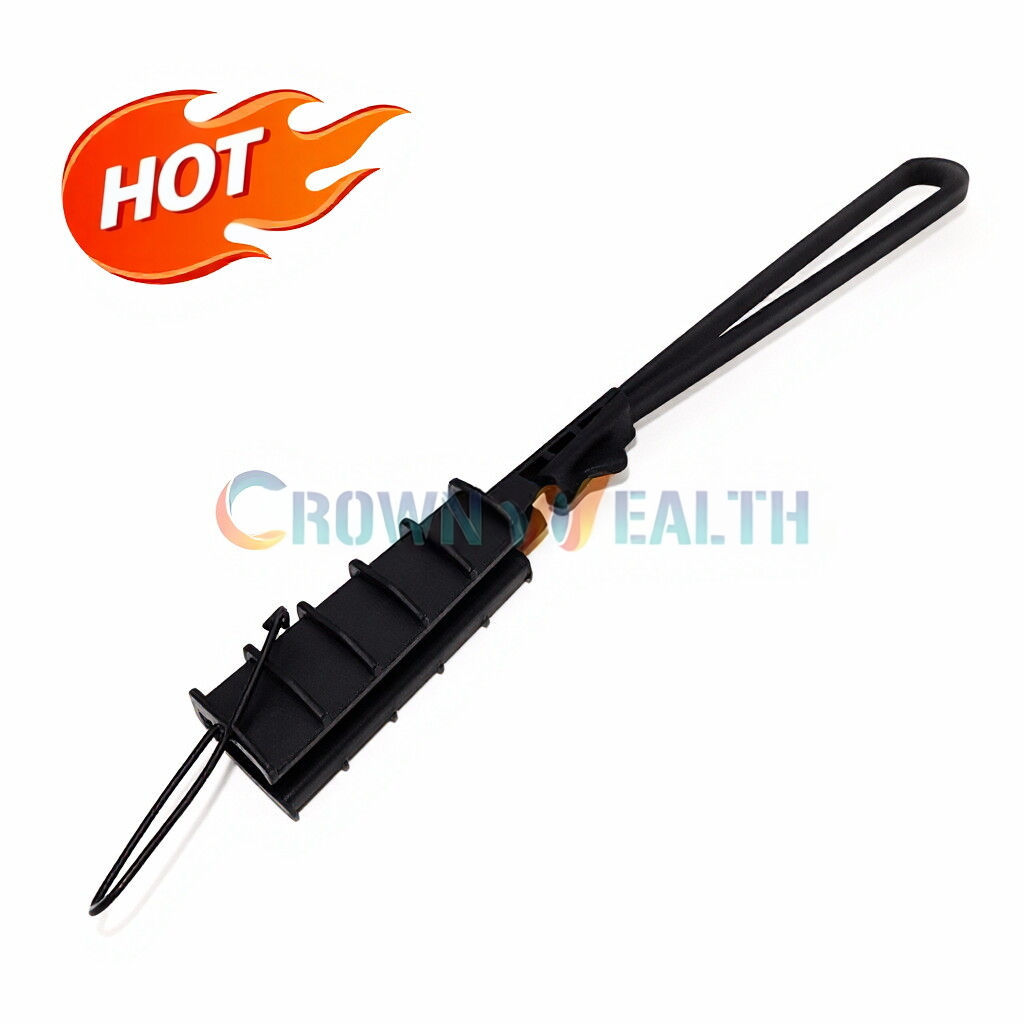
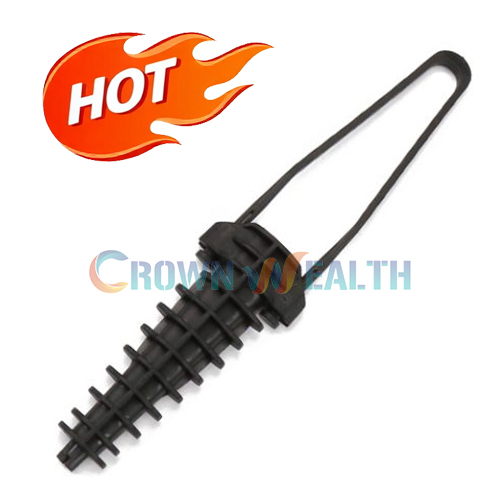
Anchor tension clamps are specialized fastening devices designed for the reliable fixation of various types of fiber optic cables to support structures such as poles and masts. These anchoring systems are engineered for ease of use, requiring no advanced technical skills for installation, and allow for the rapid completion of cable deployment projects.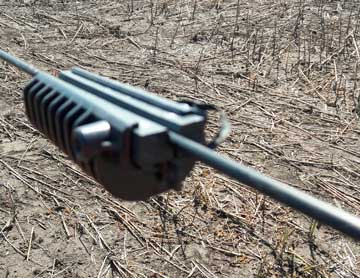
Application Areas
The primary application for anchor clamps is in the construction of communication lines along existing infrastructure. They are most commonly used on poles for lighting or electricity transmission, particularly where spans between supports are significant (commonly up to 100 meters).
This method of hanging cables from existing power line poles or lighting equipment masts is a widespread practice in modern telecommunications. Anchor clamps are essential in scenarios involving:
-
Significant changes in the height of the cable route.
-
Route direction changes (turns).
-
Cable descents or entry points into buildings.
-
Installations at civil, industrial, and unique sites utilizing load-bearing wires, glass reinforcement, or steel wire ropes.
Design Elements
A standard Anchor Tension Clamp is composed of three key components:
-
High-Strength Body: Provides structural integrity and protects internal connections from external mechanical loads and pressure.
-
Wedges: Designed to lock securely within the body, ensuring they cannot fall out during installation or operation.
-
Stainless Steel Wire Ropes: Robust loops or straps used to attach the clamp to the pole or bracket.
Types of Clamps Available
Our catalog offers a range of anchoring, wedge-shaped tension clamps suitable for different cable geometries and sizes:
-
For Self-Supporting & ADSS Cables: Specific models are available for round, self-supporting aerial cables, ADSS (All-Dielectric Self-Supporting) fiber optic cables, and "Figure-8" style cables featuring an external load-bearing element. These typically accommodate smaller diameter cables.
-
For Larger Round Cables: Dedicated clamps are available for larger diameter round cables, providing a secure grip for heavier lines.
-
For Oval or Flat Cables: Specialized wedge designs exist to properly accommodate oval or flat cable profiles, ensuring even pressure distribution and a reliable hold.
Installation Procedure
One of the key advantages of these clamps is the tool-free installation process. The procedure is straightforward and involves the following steps:
-
Mount the Clamp: Secure the clamp body to the support structure.
-
Pre-insert Wedges: Partially insert the wedges into the housing to prepare for the cable.
-
Insert Cable: Feed the cable into the designated channel within the clamp.
-
Clamp the Cable: Ensure the wedges engage the cable jacket securely.
-
Attach Hardware: Install the steel loop or strap onto the pole bracket.
-
Tension the Line: Apply tension to the cable; this action locks the wedges firmly into place, creating a permanent and reliable anchor point.
The clamp bodies and wedges are manufactured from high-strength, frost-resistant polymer materials, ensuring performance in extreme weather conditions. The wedge design allows for a secure fixation without requiring excessive force or risking damage to the cable.
Key Advantages
Compared to traditional methods of securing wires and cables, modern anchor clamps offer significant benefits:
-
High Stability and Reliability: Engineered to withstand heavy mechanical loads and environmental stress.
-
Corrosion Resistance: Constructed from materials that provide excellent protection against corrosion and aggressive environments (e.g., coastal or industrial areas).
-
Lightweight and Compact: Easy to transport and handle on site.
-
Simplified Installation: Requires no special tools, reducing labor time and costs.
-
Longevity: Compliant with international quality standards, ensuring a long service life.
Selecting the right hardware is a critical stage in network deployment, just as important as choosing the fiber optic cable itself—a decision that typically serves infrastructure needs for a decade or more. Our anchor clamps are designed to meet that standard of durability and performance.